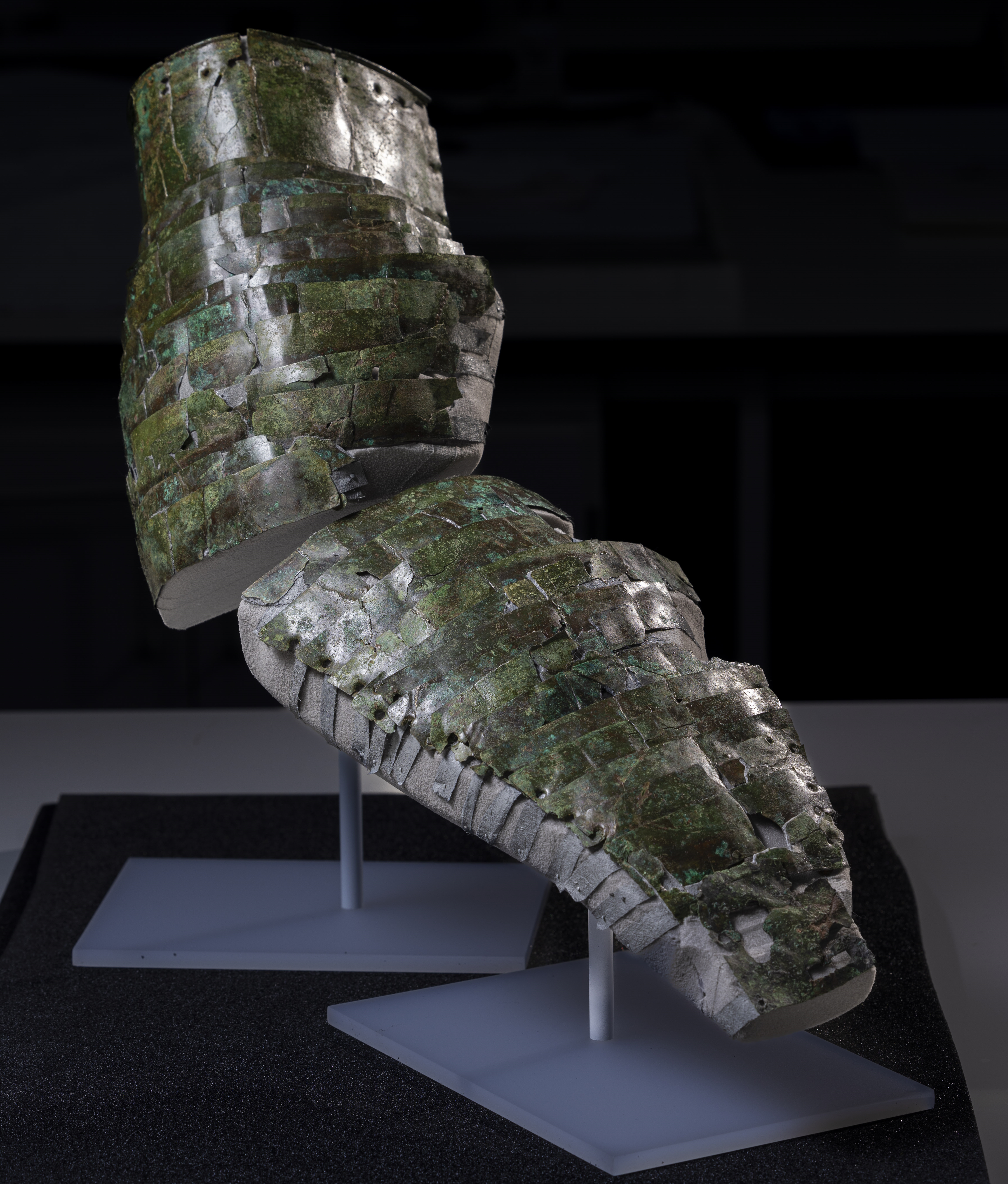
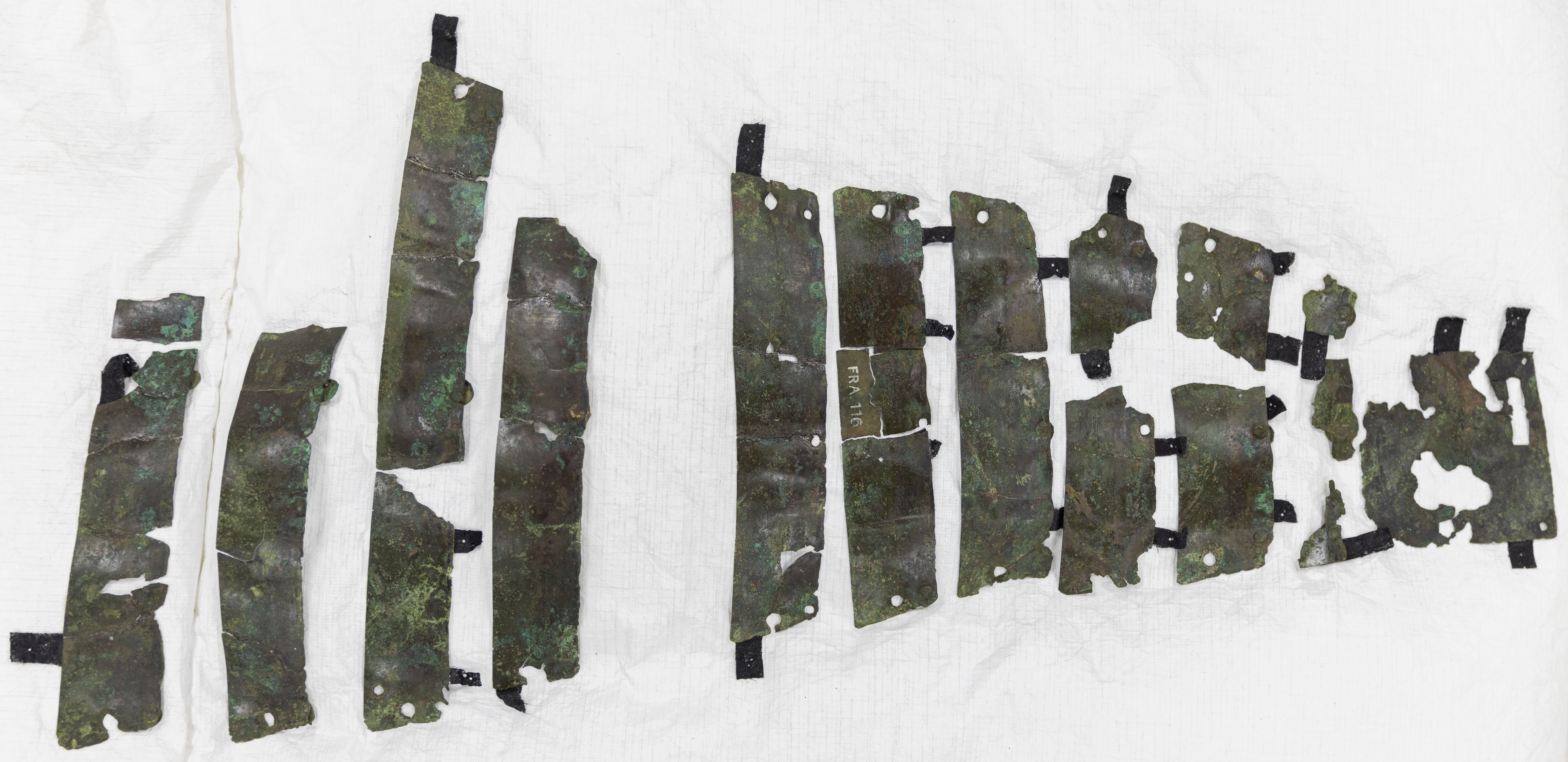
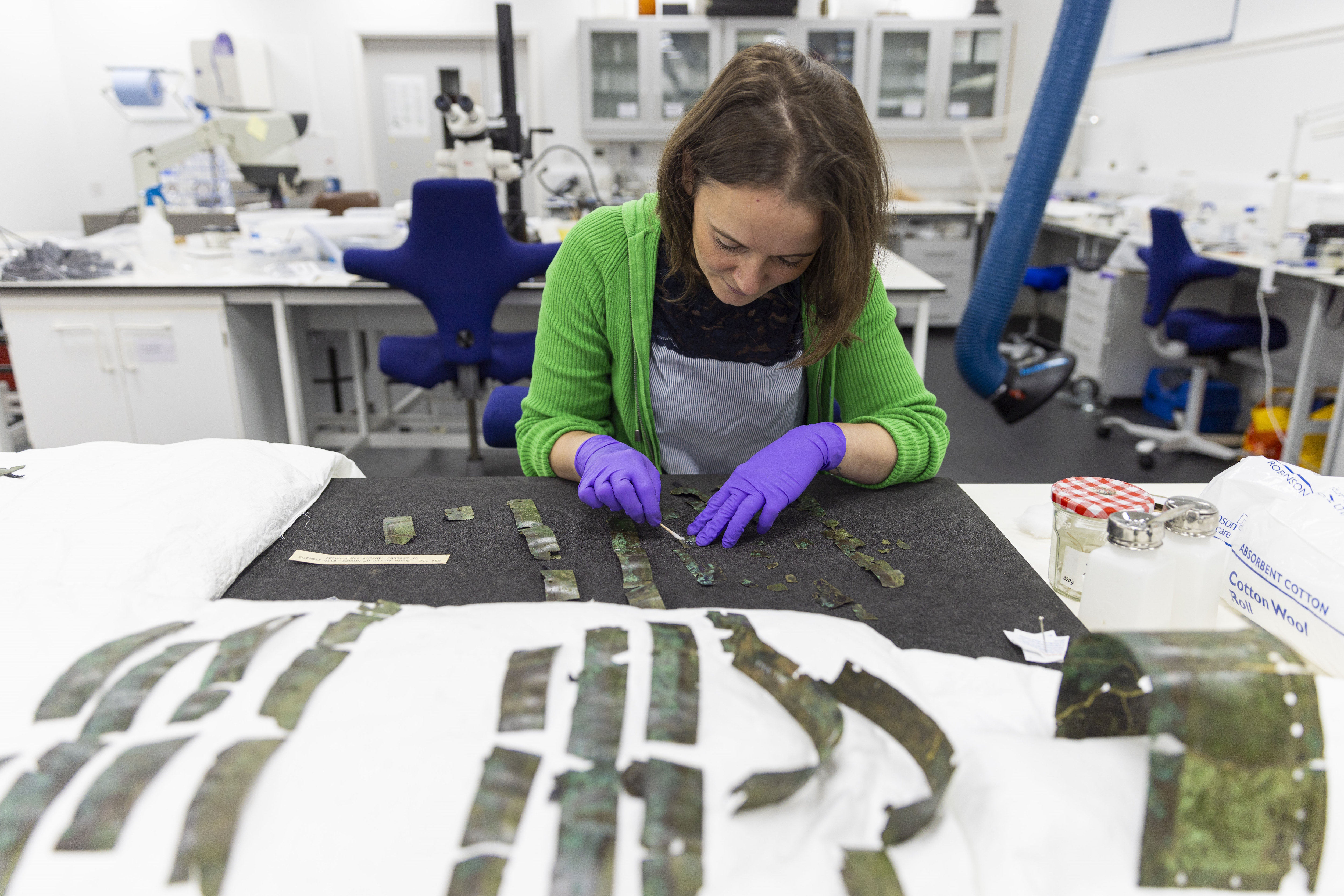
A brass Roman arm guard that was found broken in more than a hundred pieces has been reconstructed by conservators at National Museums Scotland in Edinburgh. It is one of only three Roman lorica segmentata (banded armor) arm guards known to exist today and it is by far the most complete of the three. The pieces of the arm guard were discovered in 1906 at the Roman outpost fort of Trimontium near Melrose in the Scottish Borders. They date to the 2nd century and were found in excellent condition, with pieces of the leather laces still embedded in the holes of at the ends of some of the plates.
The fragments have been in National Museums Scotland’s collection for over a century. The upper section has been on display in the National Museum of Scotland for 25 years, with the lower section loaned to the Trimontium Museum and dozens of fragments stored at the National Museums Collection Centre. They have now been brought together and assembled for the first time, offering a glimpse into the life of a legionary in Roman Scotland. Following the exhibition at the British Museum, the arm guard will go on permanent display at the National Museum of Scotland. […]
The arm guard stretches down from the shoulder and ends in a thin square of metal that would have protected the wearer’s hand, a design that may have been inspired by the equipment worn by gladiators fighting in the arena. Experts initially believed it would have been body armour, and it was later thought to be a thigh guard for a cavalryman. It is only in recent years that its true function has been understood.
First constructed in the 80s A.D., Trimontium was an enormous legionary fort (49 acres in area) that was at various times an advance outpost into Scotland, a civilian and military settlement 60 miles north of Hadrian’s Wall, a supply stop behind the front lines of the Antonine Wall, and lastly a settlement of dwindling civilian and military population until its ultimate abandonment in the late 2nd century.
 The site was rediscovered by accident during railroad construction in the 1840s. The first professional excavations took place between 1905 and 1910 under the leadership of solicitor and archaeologist Dr. James Curle. Curle’s excavations unearthed an unprecedented number and variety of Roman armature, the largest collection of Roman military objects ever discovered in Britain. Most of this armature was found in the Pincipia, the administrative headquarters of the fort, where a workshop for equipment repairs was located. When the fort was abandoned in 180, the arms and armature still awaiting repair in the workshop were left behind.
Curle mentions the arm guard fragments (and his misunderstanding of them as shoulder and chest protection) in his seminal 1911 publication of the finds, Newstead, A Frontier Post and its People.
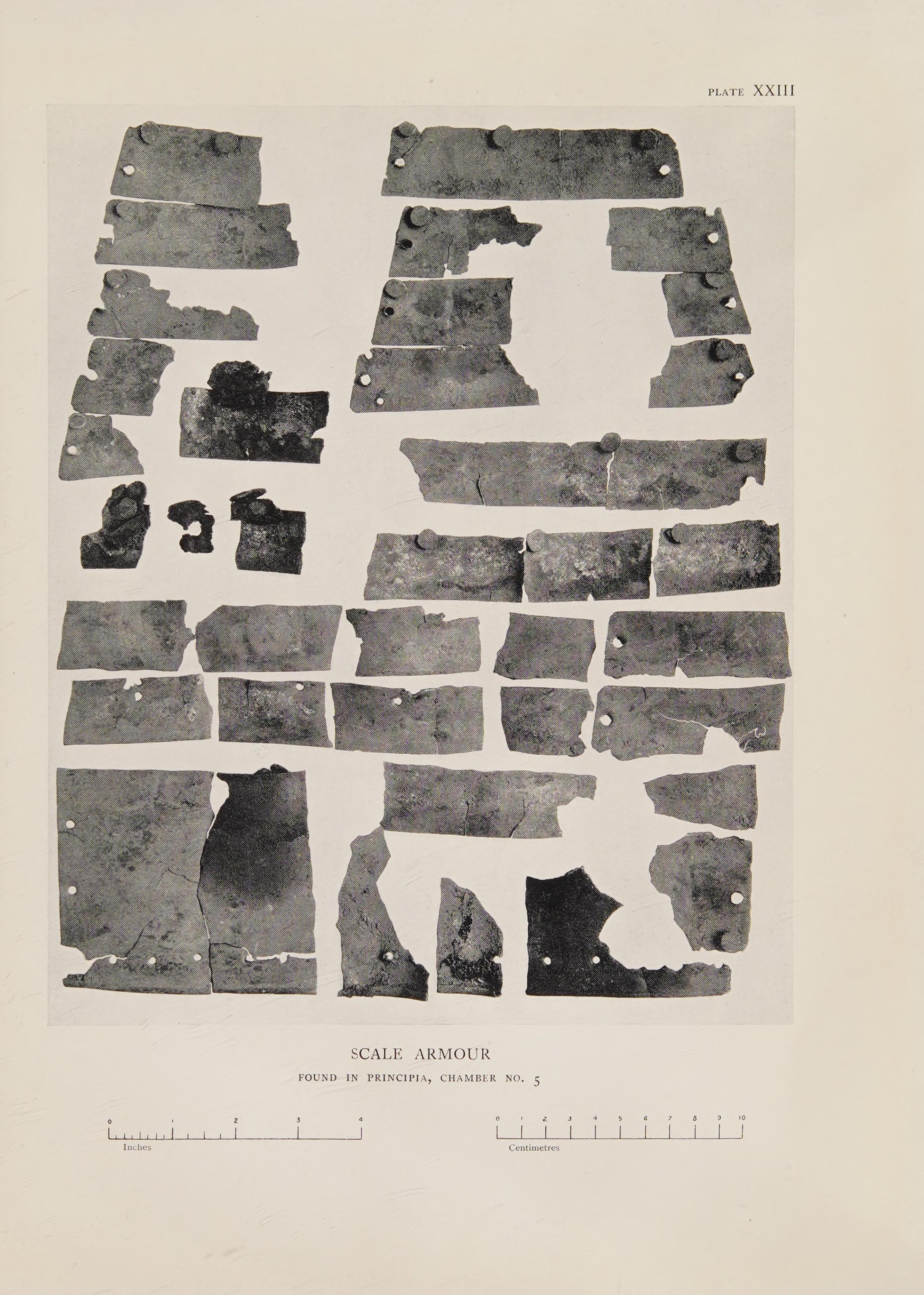
 Remains of another type of scale armour were discovered in the floor of the chamber situated at the north-west corner of the Principia. Unfortunately, here also the pieces were too small to enable the cuirass of which they had formed part to be reconstructed. Altogether there were more than one hundred fragments (Plate XXIII.). These consisted for the most part of thin plates of brass from one inch to one inch and three-sixteenths in width, slightly curved, and having a thickness of two mm. The longest piece was about three and a half inches in length. In several instances it was clear that the fragment had formed the extreme end of the band to which it belonged. In such cases it was noted that the outer margin formed an acute angle with the lower edge, but that the sharp corner was blunted in the same manner as were the corresponding parts of heavier iron bands from Carnuntum. On the concave side of the bands near the upper edge are rivets. Upon several of these there are still to be seen adhering pieces of the leather backing to which they have been attached. At the end of each band near the edge a round hole has been bored; as none of these holes were found with rivets in them, it is possible that they were used for the insertion of a cord to draw the coat together. It is quite evident from the oxydisation of the metal that when the armour was left where it was ultimately discovered, the bands were overlapping. The curve of some of the pieces suggests that they were intended to protect the shoulders and arms. Others may well have covered the body. About half a dozen pieces, the largest of which measures four inches by three and seven-sixteenths inches, may have belonged to the breastplate.
 Most legionary armor was made of iron. The brass arm guard would have shone like gold when new, so this must have belonged to an officer of high rank rather than an infantry grunt. While the shiny gold finish has oxidized to green now, the patina proved useful to conservators. Patterns of corrosion helped convey how the plates were connected, the laces tied and the padding attached.
The reconstructed arm guard goes on display at the British Museum’s Legion: Life in the Roman Army exhibition on February 1st. The show will run through June 23rd.
* This article was originally published here