The singer was criticised after her set suffered technical problems and drew a small crowd.
from BBC News https://ift.tt/ql9zRNf

Sunday, 17 November 2024

Saturday, 16 November 2024
Gladiator knife handle found near Hadrian’s Wall


The figure depicts a gladiator of the secutor class, a heavily armed fighter who carried a heavy rectangular shield and short sword. He wore a full-coverage helmet with two small openings to see through, a manica (arm guard) on his right arm and an ocrea (greave) on his left leg. The secutor was fielded again the retiarius who fought bareheaded and unshielded with a trident, net and dagger. This particular secutor is left-handed. Left-handedness was considered unlucky, so it is a distinguishing feature for a gladiator and may indicate the figure is depicting a specific fighter.
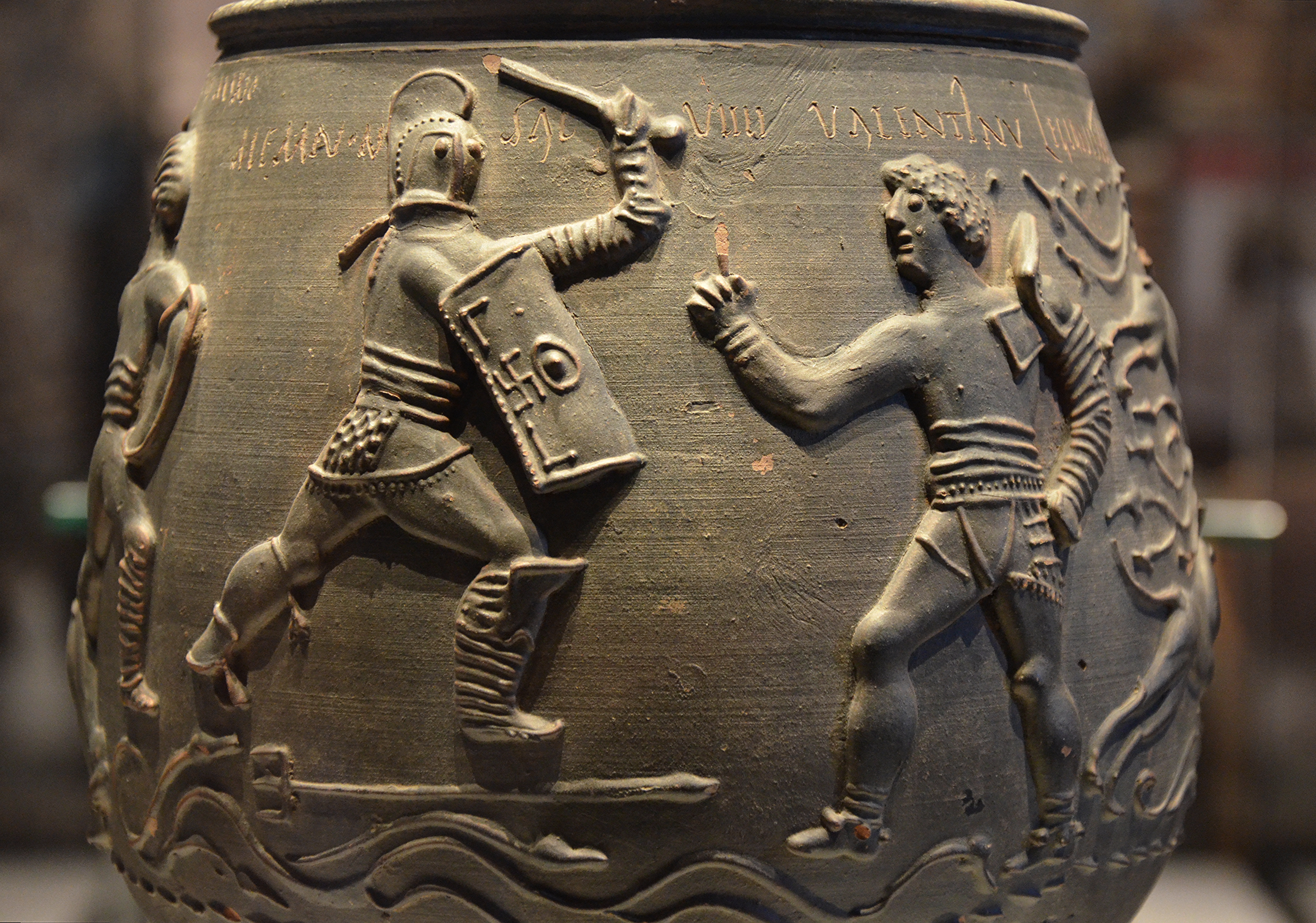
Dr Frances McIntosh, English Heritage’s Collections Curator for Hadrian’s Wall and the North East, said, ‘It is rare to find a piece of gladiator memorabilia in Britain and to find such a well preserved and interesting piece is particularly remarkable.
‘Despite being enslaved and socially outcast due to their profession, gladiators could become huge celebrities. Gladiators and the ‘spectacles’ were an integral part of Roman cultural life, taking place all across the Roman Empire. The phenomenon inspired the creation of sporting memorabilia, such as decorated ceramics and glass cups, lamps and figurines.
‘Gladiators had sex appeal and there are cases of high-status Roman women falling ‘in love’ with these lowly fighters, despite the vast social difference. This beautifully made knife handle is a testament to how pervasive this celebrity culture was, reaching all the way to Hadrian’s Wall at the very edge of the Roman Empire.”

The Tyne knife handle was finely cast and is a high-quality piece. It not mass-produced. It was likely a commissioned piece, and if it fell into the river by accident, the loss would have been much regretted.
The handle will go on display at Corbridge Roman Town in 2025 accompanied by other artifacts discovered in the River Tyne.
* This article was originally published here
Paddy McGuinness completes Children in Need challenge on kids’ bike
The presenter raises £7.5m by cycling 300 miles from Wales to Scotland on a Raleigh Chopper bike.
from BBC News https://ift.tt/D4BlmHG
from BBC News https://ift.tt/D4BlmHG
Friday, 15 November 2024
Roman hobnailed shoe found in playground in Germany

Archaeologists with the Westphalia-Lippe Regional Association (LWL) began excavating the site this summer accompanying construction work on the playground. Its proximity to the fortifications of the 1st century Roman camp of Aliso made it likely that archaeological materials were to be found at the location.

Arminius, leader of the Cherusci tribe and former ally of Rome who was responsible for the resounding defeat of three legions and the permanent derailment of all hopes of imperial expansion into Germany, besieged Aliso after his victory over the winter of 9/10 A.D. The garrison put up a great fight, and ultimately managed to escape destruction, but Aliso would be the last of the six military camps built by Augustus during his Germanic campaigns to be held by Rome after Teutoburg. The camp was occupied until 16 A.D.

LWL archaeologist Dr. Bettina Tremmel said: “A legionnaire threw his worn-out caliga into one of these waste pits and disposed of it that way. The shoe leather has now completely decomposed in the sandy soil of Haltern. However, the shoe nails that were under the sole of the shoe remained in place.”
The archaeologists tracked these down with the help of a so-called pinpointer, a compact mini metal detector. “In one place we found shoe nails lying close together and used the pinpointer to continue the search. This hit an area of 20 by 20 centimeters,” says Tremmel. The archaeologists then recovered the entire block of earth in order not to change the position of the small metal finds in the ground and to ensure that they could be transported without breakage.
“The shoe must have been relatively small and turned over in the heel area. There is a 90-degree bend there,” says LWL restorer Andreas Weisgerber. “We also looked at whether organic matter might have been preserved on the iron oxides. Unfortunately, this was not the case. Judging by the length of the nail thorn, the sole was about 0.8 centimeters thick.”
“The soles of the Caligae shoes consisted of three layers of leather, which were held together by small, hand-forged nails. The tips of the nails were folded over on the top of the sole,” adds Tremmel. “As the legionaries did not wear socks, walking on the 60 nails hammered into each sole must have been almost like a massage,” she believes.


* This article was originally published here
Why does Pharrell's biopic sidestep Blurred Lines?
Williams was fined $5m in a plagiarism lawsuit, but a film about his life doesn't touch on the issue.
from BBC News https://ift.tt/0Xhn7TY
from BBC News https://ift.tt/0Xhn7TY
Why does Pharrell's biopic sidestep Blurred Lines?
Williams was fined $5m in a plagiarism lawsuit, but a film about his life doesn't touch on the issue.
from BBC News https://ift.tt/uDtGNji
from BBC News https://ift.tt/uDtGNji
Thursday, 14 November 2024
Study Shows Smart Snacking Growing 1.2 Times Faster Than Traditional Snacks In India
A new study reveals that India's smart snacking sector is rapidly expanding as consumers seek health-focused options over traditional snacks.
from Zee News :Zee News - Health https://ift.tt/kftnHsB
from Zee News :Zee News - Health https://ift.tt/kftnHsB
Wednesday, 13 November 2024
‘King Arthur’s Hall’ is 4,000 years older than thought
A new investigation of the ancient site known as King Arthur’s Hall on Bodmin Moor in Cornwall has revealed it dates back to the Neolithic Period, 4,000 years older than previously believed. Researchers from the Cornwall Archaeological Unit (CAU) employed Optically Stimulated Luminescence (OSL) dating to discover that the enclosure was dug approximately 5,000 to 5,500 years ago, making it as old as Stonehenge, not medieval.

The site is a rectangular sunken enclosure 155 feet long and 65 feet wide outlined by an earth and stone embankment. The inner bank is lined with 56 orthostats (standing stones) up to six feet high. Most of the visible ones are leaning or lying down, but there may be more under the surface.
It was long thought to be a medieval animal pound, an enclosure for livestock, and was listed by Historic England as dating to around 1000 A.D., but there was speculation that due to the use of orthostats, its north-south orientation and the presence of other standing stone groupings nearby, at least part of the mound was much older. The rectangular enclosure with embankment and interior standing stones is unique, however. There are no known directly comparable Neolithic examples.

Test pits dug in other parts of the Hall recovered pollen, seeds, insects, parasite eggs samples for radiocarbon dating. The results found that infilling of the enclosure began about 2,000 – 2,500 years ago, and activities in the marshy interior are indeed medieval, dating to 500 – 1000 years ago, so it may have been used a pound after all, and then later as a reservoir used in tin mining.
It was first documented as “King Arthur’s Hall” in 1584, but there is no specific Arthurian legend connection claimed beyond that he visited there. The association with the legendary king may be a more recent cultural expression of a much older understanding of the site as sacred and important.
Pete Herring, president of the Cornwall Archaeological Society, said: ““The romantic sounding 16th century name King Arthur’s Hall tells us that here is a place regarded by the moorland community as something ancient and unfathomable, like other sites attributed to Arthur. Science has responded to that name’s challenge, providing a very early date of origin, and two other dates, later prehistoric and medieval, when there was activity at the enclosure.
“The monument retains its mystery: there are no Neolithic parallels for a stone-lined sunken and embanked rectangular enclosure, possibly watery. We may presume it was a sacred site, a place for gatherings, for rituals or ceremonies, but perhaps Neolithic people made and used it for very different purposes.
“Its later prehistoric and medieval dates for reuse may relate to two of Cornwall’s great sources of wealth, supporting the sustainable summer grazing of extensive commons, and then serving as a reservoir for water used in tin stream working.”

Historic England has listed the site on its Heritage at Risk Register because it is under threat from vegetation and erosion from visitors. The confirmation of its Neolithic origin will help heritage authorities develop a management plan for its long-term conservation, starting with rebuilding a fence surrounding the monument to prevent erosion from human tourists and the cattle that pasture Bodmin Moor.
* This article was originally published here
‘I lost nine teeth filming Squid Game’: On set with show’s director
The South Korean hit drama returns for a second season in December.
from BBC News https://ift.tt/awf8ysq
from BBC News https://ift.tt/awf8ysq
‘I lost nine teeth filming Squid Game’: On set with show’s director
The South Korean hit drama returns for a second season in December.
from BBC News https://ift.tt/ylstWhJ
from BBC News https://ift.tt/ylstWhJ
Tuesday, 12 November 2024
‘Who Really Wrote the Bible’ by William M. Schniedewind review
‘Who Really Wrote the Bible’ by William M. Schniedewind review
JamesHoare
* This article was originally published here
* This article was originally published here
Mattel 'deeply regrets' porn site misprint on Wicked dolls
Recently-released dolls tied to the new Wicked movie inadvertently carry the address of an adult website.
from BBC News https://ift.tt/6bwPnGB
from BBC News https://ift.tt/6bwPnGB
Subscribe to:
Posts (Atom)