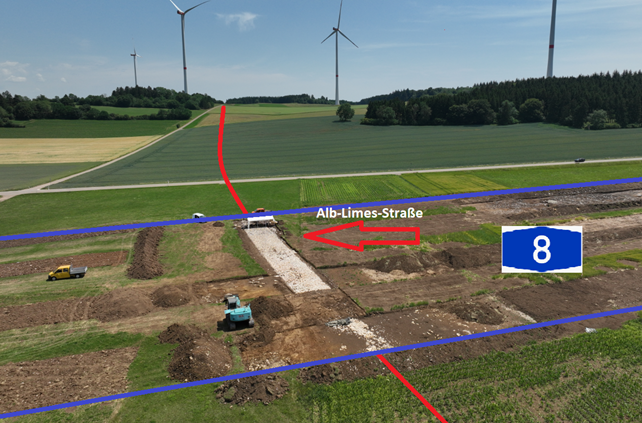
 A section of Roman road has been found at the site of planned autobahn construction near Drackenstein in southern Germany. It dates to the 1st century, likely built during the reign of .Emperor Vespasian (r. 69-79 A.D.)
 The State Office for the Preservation of Historical Monuments (LAD) at the Stuttgart Regional Council has been overseeing archaeological investigations of sites of cultural interest in advance of new highway construction on the Swabian Alb plateau.
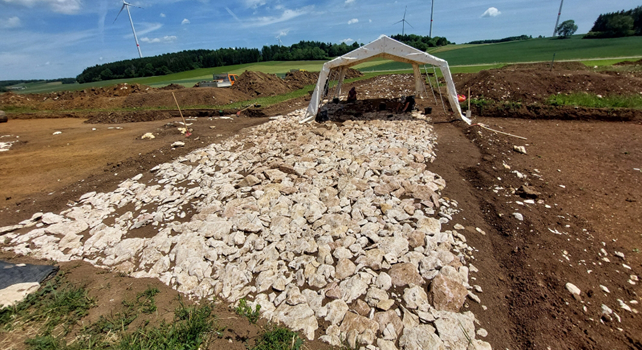
 So far, approximately 90 meters [295 feet] of the “Alblimes Road” have been excavated. This road connecting Rottweil and Heidenheim an der Brenz is one of the oldest in Baden-Württemberg and was likely built under Emperor Vespasian. Alongside the Roman forts and settlements, the “Alblimes Road” represents the crucial infrastructure of the newly established province of “Germania Superior” in the 1st century AD. It served a communicative function in terms of economic and strategic exchange and marked the border between the Roman Empire and the then-independent Germania for over a century.
 The Swabian Alb is a natural land bridge from the Rhine Falls near Schaffhausen to the Nördlinger Ries 130 miles away. As it did with the Danube, Rhine and other natural features, Rome integrated the plateau into its border, creating the “Alblimes” (Alb boundary): a series of forts built on the plateau connected by the road of the same name.
 The road was built using the striking bright white Jurassic limestone from the eroding edge of the Swabian Alb. Stones were collected and used as the foundation layer of the roadbed. They would have been covered by gravel, sand and a top layer of paving stones.
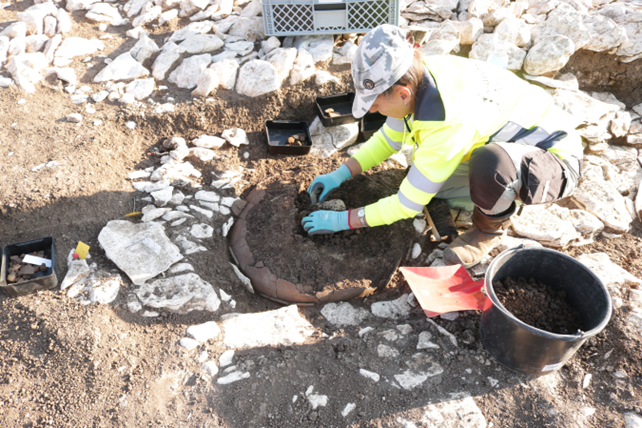
 The excavation has uncovered evidence of Roman use of the road. Objects found in the vicinity of the Alblimes road include a bronze coin from the 1st century, very worn but believed to be one issued by the Emperor Domitian, Roman iron shoe nails that studded the soles of the legionaries’ caligae (hobnailed sandals), and a Bronze Age pin with a spool-shaped head that was removed from a cinerary urn displaced during construction of the Roman road. The team also found a Bronze Age urn partly buried under the road.
* This article was originally published here




No comments:
Post a Comment