
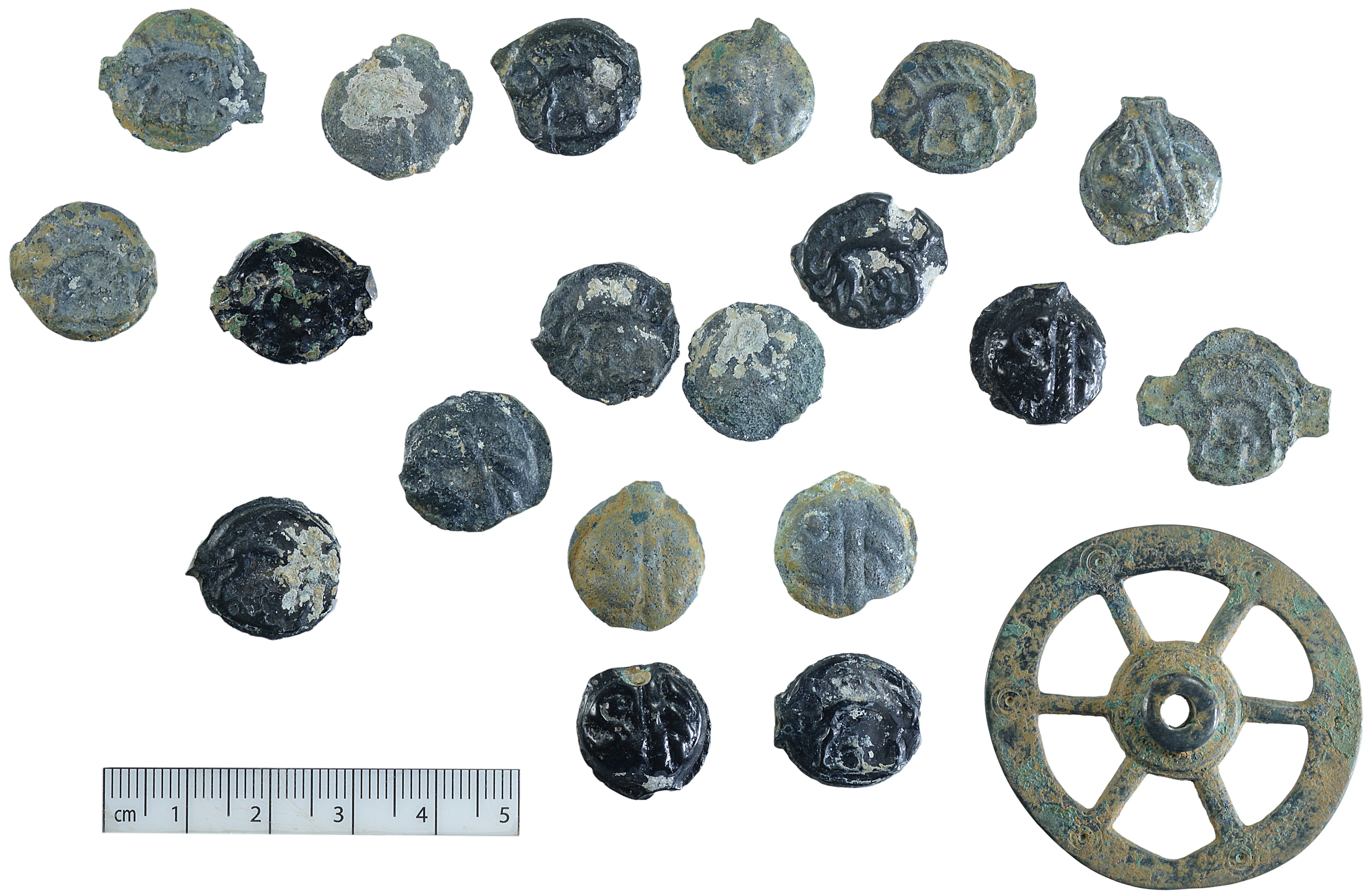
A team from the French National Institute for Preventive Archaeological Research (INRAP) found four holes in the corners of a square: postholes, evidence of a structure built on posts on a rectangular floor plan. Along one of the long side, 28 coins were discovered in a small pit.
They are Gallic potins of a type known as an “Indian head” because it bears the profile of a man wearing a headband on the reverse. This is believed to be a highly stylized modification of a coin of Philip II of Macedon. Most of the coins bear the military standard of the wild boar with stiff back bristles over a small fleur-de-lis on the obverse. The “boar standard” potin is very common in northeastern France.
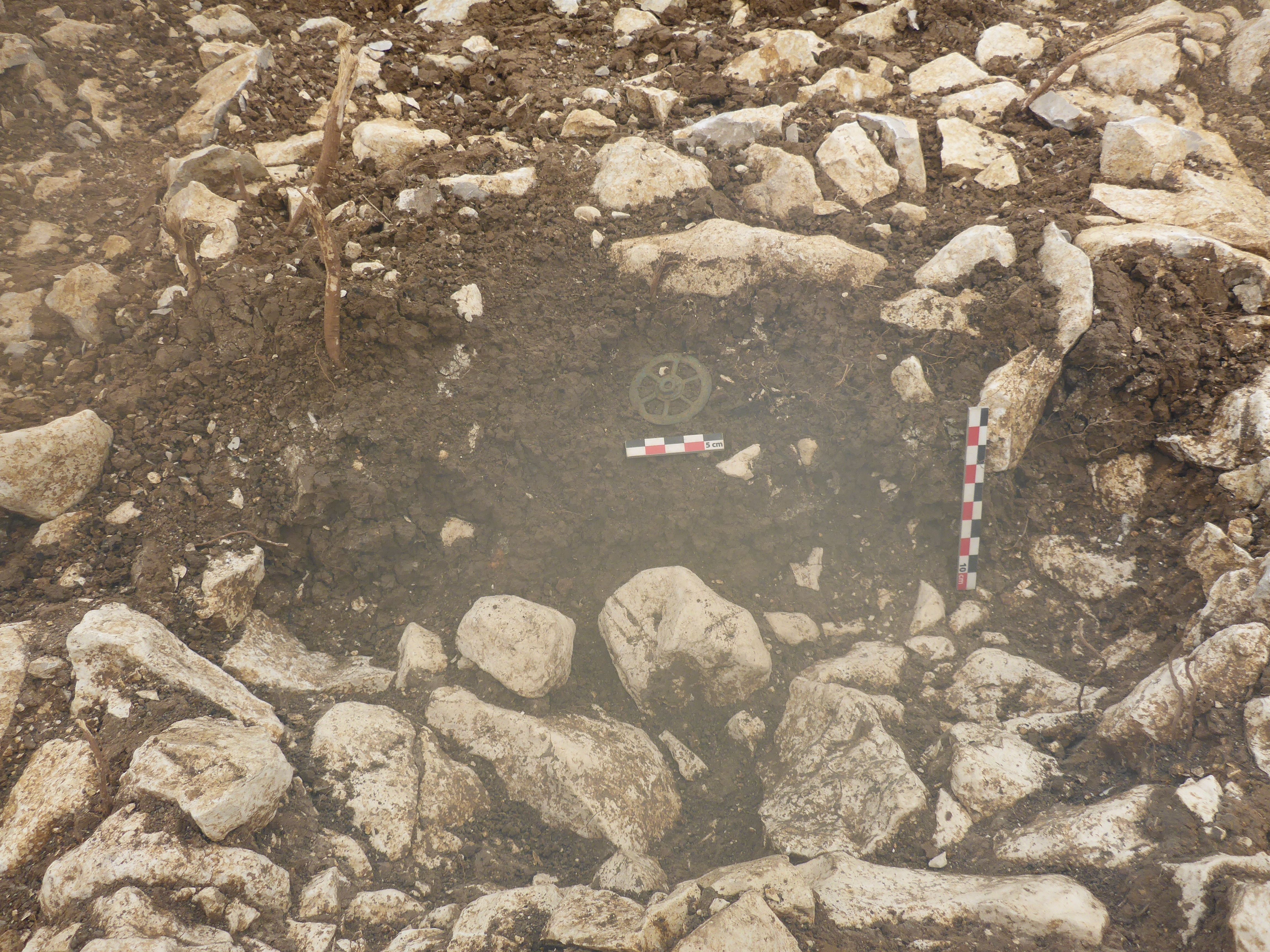
Despite their fragmentary state, the majority were skull bones (particularly the mandible). It is quite common for Gallic sanctuaries to yield human skulls, although they can also be found in domestic contexts. In the best-known examples, the sanctuaries are usually clearly demarcated by a deep ditch, as at Gournay-sur-Aronde (Oise) or Ribemont-sur-Ancre (Somme). However, perhaps due to erosion, the excavation did not reveal any demarcation system (fence, palisade, etc.). A geophysical survey was carried out a month after the fieldwork, but it failed to uncover any enclosure or other demarcation features.
If this is indeed a Gallic sanctuary, which subsequent research will attempt to verify, associated with a significant coin hoard discovered within its stratigraphic context, this archaeological occupation is unprecedented in the territory of the Leuci and very rare across Belgic Gaul.
* This article was originally published here

No comments:
Post a Comment