WHAT’S HOT NOW

GOPAL KRISHNA SAD SONGS 003

GOPAL KRISHNA SAD SONGS 002

GOPAL KRISHNA SAD SONGS 001

ಗುರುವಾರ ಕೇಳಿ ಶ್ರೀ ರಾಘವೇಂದ್ರ ರಕ್ಷಾ ಮಂತ್ರ

Friday, 3 November 2023

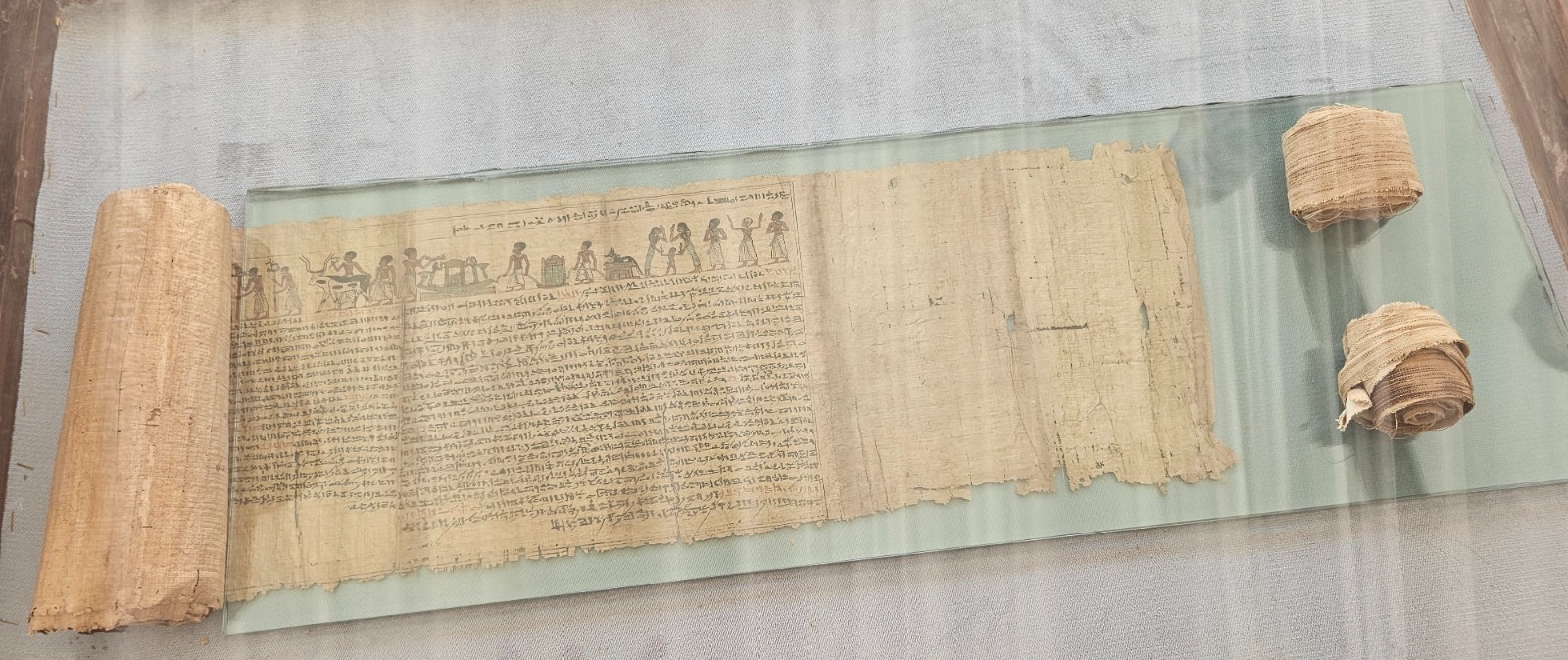
New Kingdom cemetery with complete papyrus found in Minya

A New Kingdom cemetery with richly furnished burials and a complete papyrus has been discovered in Ghoreifa near the site of Tuna El Gebel in the Minya Governorate of Upper Egypt. Thousands of artifacts were unearthed from the rock-cut tombs. Inscriptions on the funerary objects and sarcophagi identify the deceased as the senior officials and high priests of the 15th nome of Upper Egypt under the pharaohs of the New Kingdom (ca. 1550 B.C.-1069 B.C.).

The site has been excavated every season since 2017 and the Egyptian archaeological mission has been looking for the New Kingdom cemetery of the 15th nome and its capital Ashmunin this whole time. It finally emerged in the most recent excavation that began last August in the northern section of the site. Rock-cut communal tombs contained the remains of the high priests of Djehuty, god of the moon and writing, and other senior officials, buried with an enormous array of goods.

They include 16 tombs with five anthropoid limestone sarcophagi engraved with hieroglyphic texts and five well-preserved wooden coffins, some of which are decorated with the names and titles of their owners. The mission has also unearthed a collection of around 25,000 ushabti figurines made of blue and green faience, most of which are engraved with the titles of the deceased.

More than 700 amulets of various shapes, sizes, and materials have also been found, including heart scarabs, amulets of the gods, and amulets made of pure gold, such as the “Ba” and an amulet in the shape of a winged cobra.

Many pottery vessels of different shapes and sizes, which were used for funerary and religious purposes, have been unearthed, along with tools for cutting stones and moving coffins, such as wooden hammers and baskets made of palm fronds.

Two of the officials interred in the cemetery were Djehuty Mes, the overseer of the bulls of the Temple of Amun, and a woman named Nany, who bore the title “Djehuty’s singer.” Another was Tadi Ist, daughter of Eret Haru, the high priest of Djehuty in Ashmunin. The canopic vessels containing her organs were found in two wooden boxes next to her beautifully painted and carved coffin. The inner part of the lid of her sarcophagus is painted with figures representing the 12 hours and a central figure who bears a striking resemblance to Marge Simpson. Within the coffin, Tadi Ist’s mummified body wears a gilded mask and a delicate beaded dress in remarkably intact condition.

The papyrus is a Book of the Dead in an excellent state of preservation. It has not been fully unrolled yet, but archaeologists estimate it is between 40 and 50 feet long. It is the first complete papyrus found in the Al-Ghoraifa area. When it has been conserved and stabilized, it will go on display at the Grand Egyptian Museum in Cairo.


* This article was originally published here

Forensics T&P Director | PricewaterhouseCoopers

The Role Line of Service Advisory Industry/Sector Not Applicable Specialism Forensic Technology Management Level Director Job Description & Summary A career in our Disputes and Claims practice, within Disputes and Claims services, will provide you with the opportunity to help our clients understand where they might h...

source http://www.gulftalent.com/uae/jobs/forensics-t-p-director-393411?utm_source=feed_subscriber&utm_medium=referral&utm_campaign=rss_feed

How To Manage Stress In Workplace And Not Be Overwhelmed - Experts Share 10 Tips

International Stress Awareness Week: In an increasingly fast-paced and demanding world, stress is not an issue that can be dismissed or ignored. Stress in the workplace can be especially debilitating and impact physical and mental health. So it's key to know how to cope with stress. 

from Zee News :Zee News - Health https://ift.tt/ViEhl6I

Thursday, 2 November 2023

Michelangelo’s Secret Room opens to the public

Forty-eight years after it was first discovered, the room where Michelangelo was said to have hidden from his political enemies for three months in 1530 is officially opening to the public. Whether Michelangelo actually secreted himself in the room under the New Sacristy of the Basilica of San Lorenzo until the coast was clear is unknown, but his masterful drawing is seen all over the walls.

The space is cramped, to say the least, at just 23 feet long, 6.5 feet wide and eight feet high at the highest point of the vault. The walls are decorated with figural studies, most of them larger-than-life-size, many of them overlapping, drawn in sticks of carbonized wood and red chalk. Subjects include the head of Laocoön from the ancient masterpiece of sculpture that Michelangelo had seen unearthed in 1506. Other figures reference sculptures and artworks by Michelangelo himself, like the legs of Giuliano de’ Medici from the marble idealized portrait Michelangelo sculpted for the tomb of Giuliano in the Medici chapel just above the secret room.

Michelangelo worked on the Medici mortuary chapel in the New Sacristy off and on from 1519 until his permanent move to Rome in 1534. Things only got hairy in 1527, when political upheaval after the Sack of Rome by the troops of Holy Roman Emperor Charles V spurred Florence to revolt against Medici rule and install a Republic. Michelangelo was closely involved in the Florentine Republic, appointed by the government as one of the Nine of the Militias, in charge of the fortifications of a city that was soon to be besieged by the combined forces of Spain, the Holy Roman Empire and their new ally Clement VII.

The siege was protracted, lasting a grueling 10 months until Florence finally surrendered on August 10th, 1530. Michelangelo was in the cross-hairs of Clement and the Medici, now restored to power. So he hid somewhere and he was so adept at it that even his contemporary biographers could only guess at his location. He emerged in November when the Pope announced that Michelangelo would be pardoned if he went back to work on the Medici tombs in the New Sacristy. Little did Clement know Michelangelo had been steps away from it the whole time.

The room, never publicly known or documented, was put to practical uses. The walls with their glorious sketches were plastered over (twice) and it was a charcoal dump until the middle of the 20th century when the trap door leading to it was covered with furniture. It was rediscovered in November of 1975 when restorers were cleaning a corridor under the New Sacristy on the hunt for a new possible exit for the Museum of the Medici Chapels.

The director of the Museum of the Medici Chapels at that time, Paolo Dal Poggetto, decided not to open the room to the public out of concern that the charcoal drawings would be damaged by exposure to crowds. Every once in a while someone pulled some strings and got a tour, but the general public has never been allowed to lay eyes on the walls before. The closest they’ve gotten is high-resolution images and video of the drawings displayed in several of Florence’s museums.

The completion of a new exit (the same one they were looking to build in 1975 when they found the room) and modern technology has made it possible to made the Secret Room accessible to the public in a controlled way. A maximum of four people at a time will be allowed into the room for reserved time slots for only 15 minutes with a maximum of 100 people per week. Conservation conditions will be scrupulously monitored and the new LED lighting, installed in 2018, will only be on for brief periods, alternating with long hours of darkness.

The room will open on November 15th for an experimental run lasting until March 30th, 2024. Tickets will cost a total of 38 euros and can be booked online here.


* This article was originally published here

The Beatles' final song Now And Then: When is it out and what will it sound like?

The Fab Four's "emotional" farewell single Now And Then is being made available on Thursday.

from BBC News - Entertainment & Arts https://ift.tt/atHOu3o

The Beatles' final song Now And Then: When is it out and what will it sound like?

The Fab Four's "emotional" farewell single Now And Then is being made available on Thursday.

from BBC News - Entertainment & Arts https://ift.tt/53VaSYM

London City Ballet gets new lease of life nearly 30 years on

The original London City Ballet toured internationally but ceased operations in 1996.

from BBC News - Entertainment & Arts https://ift.tt/aOgKLT0

London City Ballet gets new lease of life nearly 30 years on

The original London City Ballet toured internationally but ceased operations in 1996.

from BBC News - Entertainment & Arts https://ift.tt/ZLVNiho

Wednesday, 1 November 2023

First Celtic settlement found in Munich

The remains of a large Celtic settlement of the La Tène people have been discovered in Lerchenauer Field, a northern suburb of Munich. About 2,300 years old, this is the first Celtic village ever found in Bavaria.

The site was excavated by the Bavarian State Office for Monument Preservation in advance of construction of a new housing development. Archaeologists discovered circular discolorations filled in with soil and gravel and identified them as post holes that would have once supported the roofs of Iron Age homes. The dwellings were varied in size and floor plan. Traces of wattle and daub indicate they were half-timbered wooden houses.

Extrapolating from the number of post holes, archaeologists have concluded this was a settlement with more than 100 houses, a significantly higher number of dwellings than found in other Iron Age settlements. It would have been able to house a population of at least 500, making it something of an urban metropolis for that time and place. Archaeologists have long believed that the urban area of what is now Munich had numerous large villages in the Iron Age based on important individual finds from the period, but the Lerchenauer Field find is the first actual settlement to be discovered in Munich.

Two groups of graves were also found from different periods of occupation of the site first by Celts and then by Romans. One is from the late Iron Age (450 – 15 B.C.), and the other from the late Roman Imperial period (3rd-4th c. A.D.). Artifacts of note found in late Roman graves include a set of tableware — a plate, a jug with a handle and a drinking cup — made of soapstone, and a sickle blade. Sickles are very rarely discovered in graves.

The Roman graves were associated with a settlement that was built in the same area as the previous Celtic one. It was more modest in size and population than its predecessor. It was abandoned after the demise of the Western Roman Empire

Because of the importance of the finds, the developers are cooperating fully with the state archaeologists to expand the excavation. It will continue into 2024 to ensure that all archaeological remains are salvaged before construction begins.


* This article was originally published here

AI named word of the year by Collins Dictionary

Usage of the acronym for artificial intelligence has quadrupled this year, the publisher says.

from BBC News - Entertainment & Arts https://ift.tt/RusdXtJ

AI named word of the year by Collins Dictionary

Usage of the acronym for artificial intelligence has quadrupled this year, the publisher says.

from BBC News - Entertainment & Arts https://ift.tt/CBdkMV5

Channing Tatum and Zoe Kravitz engaged - US media

The Magic Mike actor and Batman actress, who have been dating for two years, are to get married.

from BBC News - Entertainment & Arts https://ift.tt/WRSrIG6

Channing Tatum and Zoe Kravitz engaged - US media

The Magic Mike actor and Batman actress, who have been dating for two years, are to get married.

from BBC News - Entertainment & Arts https://ift.tt/CspL0ry