
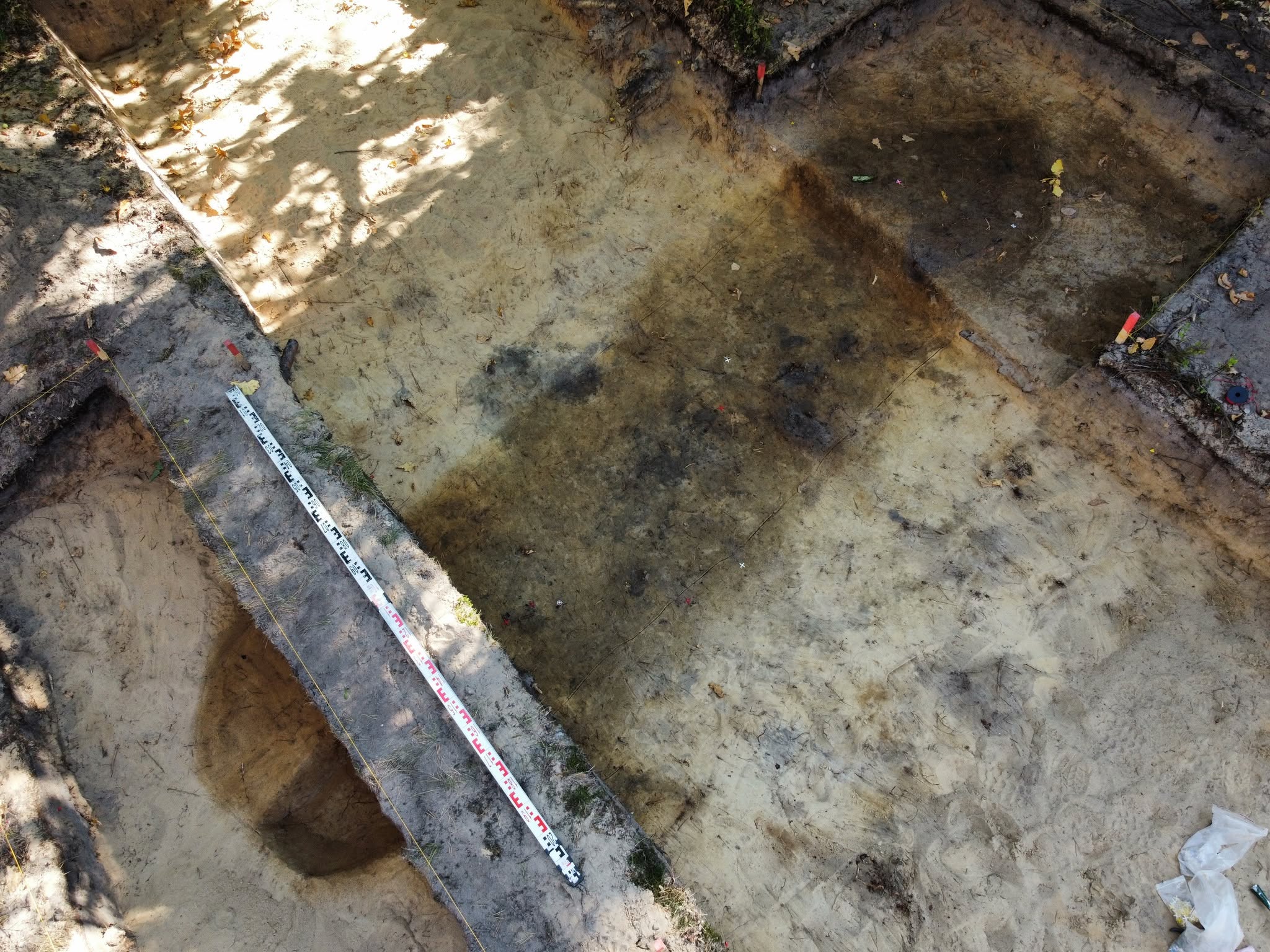
A team of archaeologists from the Institute of Archaeology and Ethnology of the Polish Academy of Sciences (IAE PAN) discovered the remains of the boat burial between two other graves, one burial mound, one with a monument designed to look like a house. It is 1.2 meters wide at the widest point and has the shape of a dugout canoe. Cremated remains were placed in the shape, although it is not yet clear whether there was an actual boat as any wooden remains have decomposed leaving only a dark stain in the soil.
The first clue to the grave’s unusual character came from a beautifully preserved silver ornament near its upper surface. Archaeologists identified it as an early medieval temple ring, decorated with hollow beads and delicate granulation—a technique in which craftsmen attached tiny metal spheres to create intricate patterns.
As excavations continued, the team recovered more than a dozen small fragments of silver jewelry, some partially melted by fire. They also uncovered pieces of ceramic vessels, charcoal, and burned human and animal bones, suggesting that the funeral involved more than the simple deposition of cremated remains.
Among the animal remains, one discovery particularly interested the researchers: a horse tooth. Its presence is unusual in the wider context of Slavic burial traditions, although Chodlik has already produced several cremation graves containing horse remains.

Chodlik is one of the most important archaeological sites in the Lublin area. It contains the remains of an early medieval settlement was centered around a fortified stronghold built by the Slavs between the 8th and the 10th century. IAE PAN archaeologists have been excavating and surveying it for 12 years, uncovering burial mounds, a cremation cemetery, arrowheads, spears, the longitudinal rampart of the stronghold and pottery fragments. This year’s dig also uncovered the remains of the early medieval settlement outside the boundary of the fortress.

The team is currently working on creating a comprehensive 3D reconstruction by merging digital documentation of each burial layer with records of individual artifacts. Through radiocarbon dating and expert examination, researchers hope to eventually determine when the grave was built, how it was constructed, and what the funeral circumstances were like.
* This article was originally published here

No comments:
Post a Comment